
When a Mother’s Tragedy Becomes a Mirror: What the Lindsay Clancy Case Is Asking Us to See
When a Mother’s Tragedy Becomes a Mirror: What the Lindsay Clancy Case Is Asking Us to See — PLAE
There is something profound about the way the story of Lindsay Clancy has captured the minds, the time, and the hearts of so many people—particularly so many women.
I have found myself deeply invested, too.
And as I have sat with that investment and tried to understand why this case feels so different—why so many people seem unable to simply look away—it has become increasingly clear to me that this story is touching something much larger than one woman, one marriage, one family, or even one criminal trial.
It is touching a wound.
The circumstances surrounding Lindsay Clancy bring into painful focus the enormous gaps that still exist in the way we care for women, particularly mothers experiencing mental health crises.
They remind us that even when a woman desperately seeks help, even when skilled providers exist within our communities, even when she enters treatment and communicates that something is wrong, our systems can still fail.
And sometimes those failures have catastrophic consequences.
This case shines an especially critical light on mothers operating under extreme overwhelm—women whose bandwidth has been stretched beyond anything sustainable, who communicate their needs, their fears, their pain and their limitations, yet somehow remain unseen or insufficiently supported.
There is a long history of women not being believed when we communicate pain.
There is a long history of minimizing women’s symptoms, women’s intuition about their own bodies, women’s exhaustion and women’s declarations that something is wrong.
Whether we call that internalized misogyny, cultural conditioning, inadequacies in healthcare, or simply the normalization of mothers carrying impossible loads, we need to be willing to examine it.
Because women should not have to completely collapse before someone believes that they are drowning.
She Asked for Help
Perhaps one of the most haunting elements of this case is hearing about the many attempts Lindsay reportedly made to obtain help.
We hear testimony about treatment.
We hear about medication.
We hear questions surrounding medication management.
We hear about her communications and journals.
We hear about a mother seemingly consumed with concern about nearly every aspect of her children’s lives.
And we are left confronting a deeply uncomfortable question:
How can someone come into contact with so many people and systems and still somehow remain so profoundly unsupported?
The trial is ongoing, and there has been no verdict. There are facts being contested in a courtroom, evidence being challenged, and competing interpretations of what happened inside that home.
That distinction matters.
But regardless of what a jury ultimately determines, the questions this case raises about maternal mental health will remain.
The Woman We See in the Courtroom
There is also something incredibly difficult about watching Lindsay herself.
Her body now carries the permanent consequences of what happened that night. She is paralyzed after surviving her fall from the second-story window of her home.
And viewers watching the proceedings are seeing a woman whose body language can appear defeated, whose eyes sometimes seem hollow, sitting in a courtroom while the most devastating moments of her life are reconstructed around her.
At times, it has appeared as though she is processing pieces of this history alongside everyone else.
We cannot know from watching a courtroom feed exactly what is happening inside another human being. We should be careful about pretending that we can.
But we can recognize humanity when we see it.
And one of the things that has profoundly affected many people watching this trial has been seeing her attorney fiercely advocate for her while simultaneously demonstrating tenderness toward her.
He challenges evidence.
He raises questions.
He brings forward information the defense believes has been overlooked or misunderstood.
And then, during extraordinarily painful moments, we see him reach over and hold her hand.
Such a small gesture.
Yet somehow, against the enormity of everything surrounding this case, it feels enormous.
Perhaps that is because so many people watching have wondered whether someone should have held her hand much sooner.
Whether someone should have stayed.
Whether someone should have recognized that asking for help and actually being held safely through a crisis are two very different things.
There is something deeply moving about finally seeing someone visibly show up for her.
And there is something unbearably tragic about knowing that we are seeing it only after three children are gone and their mother’s life was nearly a fourth.
Where Was the Village?
This case has also made me think deeply about how we raise families today.
We talk endlessly about the importance of “the village.”
But where is it?
I am increasingly unconvinced that human beings were ever intended to raise children in the degree of isolation that has become normal in modern life.
A mother can live inside a neighborhood full of houses and still be alone.
She can have people around her and still be alone.
She can be married and still experience profound loneliness.
She can have doctors, appointments, prescriptions and treatment plans and still not feel held.
We have created a culture in which families are expected to function as tiny, self-contained islands. Parents are supposed to work, maintain households, raise children, manage appointments, nurture marriages, maintain careers, remember everything, coordinate everything and somehow remain emotionally healthy through all of it.
And mothers, in particular, are frequently expected to absorb whatever remains.
Something has been lost.
Communities need to become communities again.
Neighborhoods need to become neighborhoods again.
We need to know one another.
We need to notice when someone disappears.
We need to bring dinner without waiting for someone to become desperate enough to ask.
We need to sit with the mother who hasn’t slept.
We need to recognize when exhaustion has crossed into something more dangerous.
We need to stop assuming that because someone has a spouse, a beautiful home, healthy children, professional resources or access to medical care, she must therefore be okay.
Physical proximity is not the same thing as support.
I also recognize that the capacity to do these things is limited because so many are operating within the same system of overwhelm.
Postpartum Mental Health Cannot Be an Afterthought
And then there is the issue at the center of so much discussion surrounding this case: postpartum mental health.
Postpartum depression deserves serious attention.
Postpartum psychosis demands it.
The postpartum period can represent an extraordinarily vulnerable time, and when a woman is experiencing severe psychiatric symptoms, we cannot treat support as optional or assume she can simply power through.
A woman in a serious postpartum psychiatric crisis should not be left to navigate that crisis alone.
Families need education.
Partners need education.
Healthcare providers need systems that communicate with one another.
Medication management needs careful oversight.
Warning signs need to be understood.
And when a woman repeatedly communicates that something is wrong, our response cannot simply be another instruction for her to somehow manage herself.
We need systems capable of surrounding her.
Because sometimes the person experiencing a psychiatric crisis is the least capable person in the room of determining exactly what she needs.
That is precisely why the rest of us have to know what to do.
This Is Bigger Than One Verdict
Three children lost their lives.
Nothing about discussing maternal mental health should ever diminish the enormity of that truth.
Their lives matter.
Their deaths matter.
Their mother matters, too.
Those truths do not have to compete with one another.
A criminal trial will attempt to answer specific legal questions about responsibility, intent, evidence and culpability. The jury will ultimately decide the questions placed before it.
But society has other questions to answer.
What happens when a mother tells us she is not okay?
How many times should she have to say it?
What responsibility do healthcare systems have when medications, diagnoses and symptoms become extraordinarily complicated?
What responsibility belongs to partners and families?
What does meaningful support actually look like?
How do we distinguish between someone who needs encouragement and someone who should not be left alone?
And how many tragedies will it take before maternal mental healthcare is treated with the urgency it deserves?
I think that is part of why so many women cannot stop watching.
Some recognize the exhaustion.
Some recognize the isolation.
Some remember their own postpartum period.
Some remember trying to tell someone that they weren’t okay.
Some remember being dismissed.
And some are watching a woman sitting in a courtroom and thinking about how differently a life might unfold when the right person listens at the right moment.
I keep returning to one thought:
She is the kind of client I wish had walked through my door before any of this happened.
I wish someone had been able to advocate fiercely enough, early enough, to help ensure that she was heard, surrounded and safe.
Not because we know what the verdict should be.
Not because those beautiful children should become secondary to their mother’s story.
But because prevention happens before a courtroom.
It happens in kitchens.
In doctors’ offices.
In psychiatric appointments.
In conversations between spouses.
In neighborhoods.
In friendships.
In someone noticing that the mother who says she cannot do this anymore may not be speaking figuratively.
Perhaps the reason this case has captured so many hearts is because beneath all of the legal arguments, testimony and disputed evidence is a question that reaches far beyond Lindsay Clancy:
What would happen if we actually believed women when they told us they were reaching their limit?
And what might be prevented if, instead of waiting for mothers to completely fall apart, we built communities willing to catch them?
We cannot undo what happened to this family.
Three children are gone.
A mother is permanently changed.
An entire family will carry this tragedy forever.
But we can refuse to look away from what their story is asking us to examine.
We can build better systems.
We can take postpartum mental health seriously.
We can listen sooner.
We can show up differently.
We can become villages again.
And perhaps we can make sure that the next mother who whispers—or screams—I need help does not have to keep saying it until it is too late..


Understanding Mood Disorders with Compassion; A gentle conversation about emotional well-being, healing, and hope. Finding Your Way Back to Yourself
🌿 Understanding Mood Disorders with Compassion
A gentle conversation about emotional well-being, healing, and hope.
Finding Your Way Back to Yourself
When you’re living with a mood disorder, it’s common to hear things like:
“Just stay positive.”
“Take it one day at a time.”
“Try not to think about it so much.”
While often well-intended, healing is usually much more complex than that.
Many people describe their experience not as wanting to become someone new, but simply wanting to feel like themselves again.
🌱The version of themselves that felt connected.
🌱The version that laughed more easily.
🌱The version that felt present in their own life.
🌱The truth is, healing doesn’t usually happen through one big breakthrough.
More often, it unfolds in small, quiet moments.
🌱 Getting out of bed
🌱 Taking a shower
🌱 Going for a short walk
🌱 Attending therapy
🌱 Asking for help
🌱 Giving yourself permission to rest
At PLAE, we believe progress isn’t measured by perfection.
It’s measured by the small ways you continue showing up for yourself, even when things feel difficult.
And if today all you did was make it through the day, that counts too.
Healing isn’t about becoming someone different.
Sometimes it’s about gently finding your way back to yourself.
🌿 A Gentle Reflection:
What is one small thing you’ve done recently that made you feel more connected to yourself?
🌿 A Gentle Reminder
If any part of this message resonates with you, please know that you don’t have to navigate it alone.
Whether you’re experiencing symptoms of a mood disorder, moving through a difficult season of life, or simply feeling unlike yourself lately, support is available.
At PLAE, we are honored to walk alongside individuals and families with compassion, care, and hope as they move toward healing and well-being.
🌱 We are currently accepting new clients and do not maintain a waitlist for those seeking care.
🍃 To learn more or schedule an appointment, visit www.plaetherapy.com
🌿 With compassion,
The PLAE Therapy Team
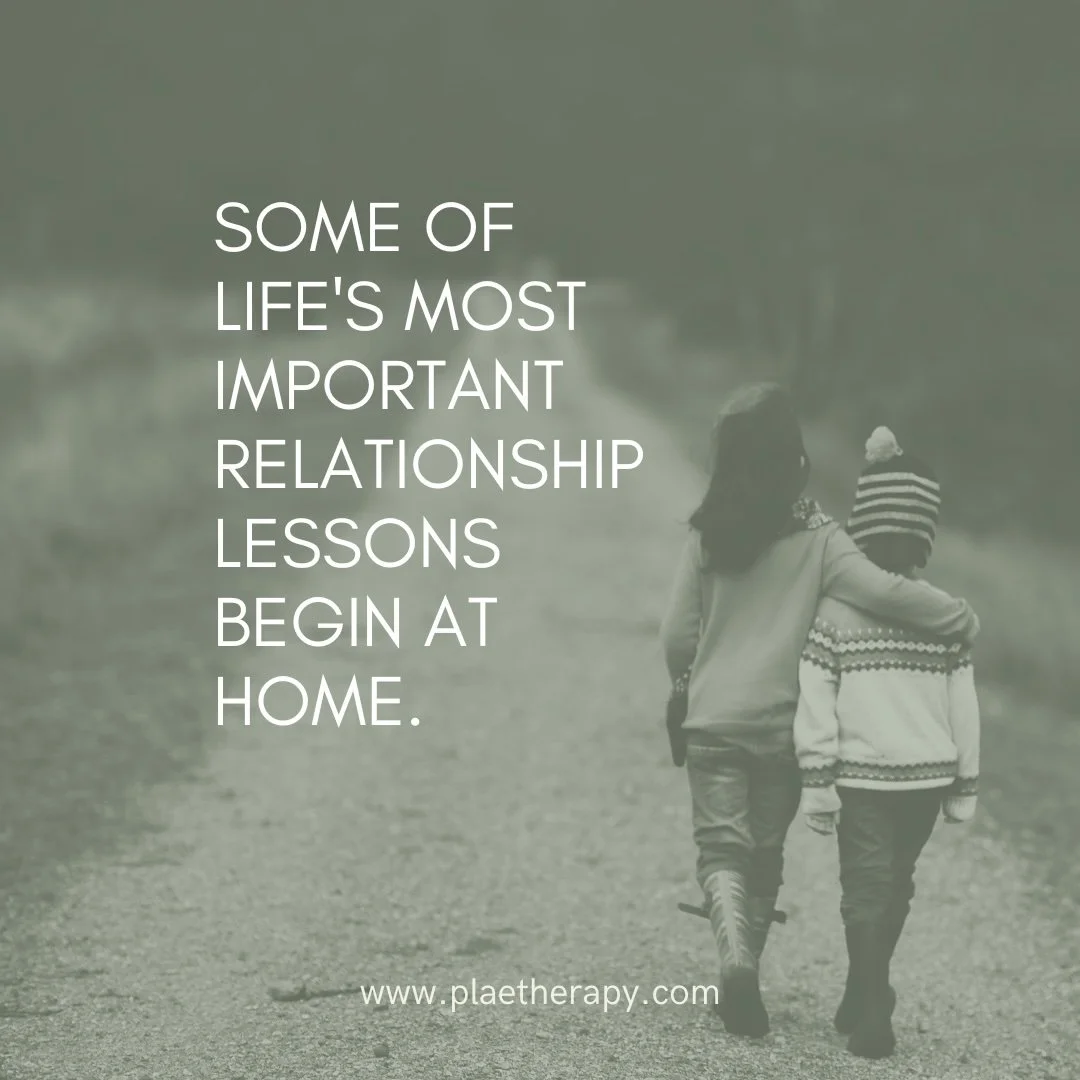
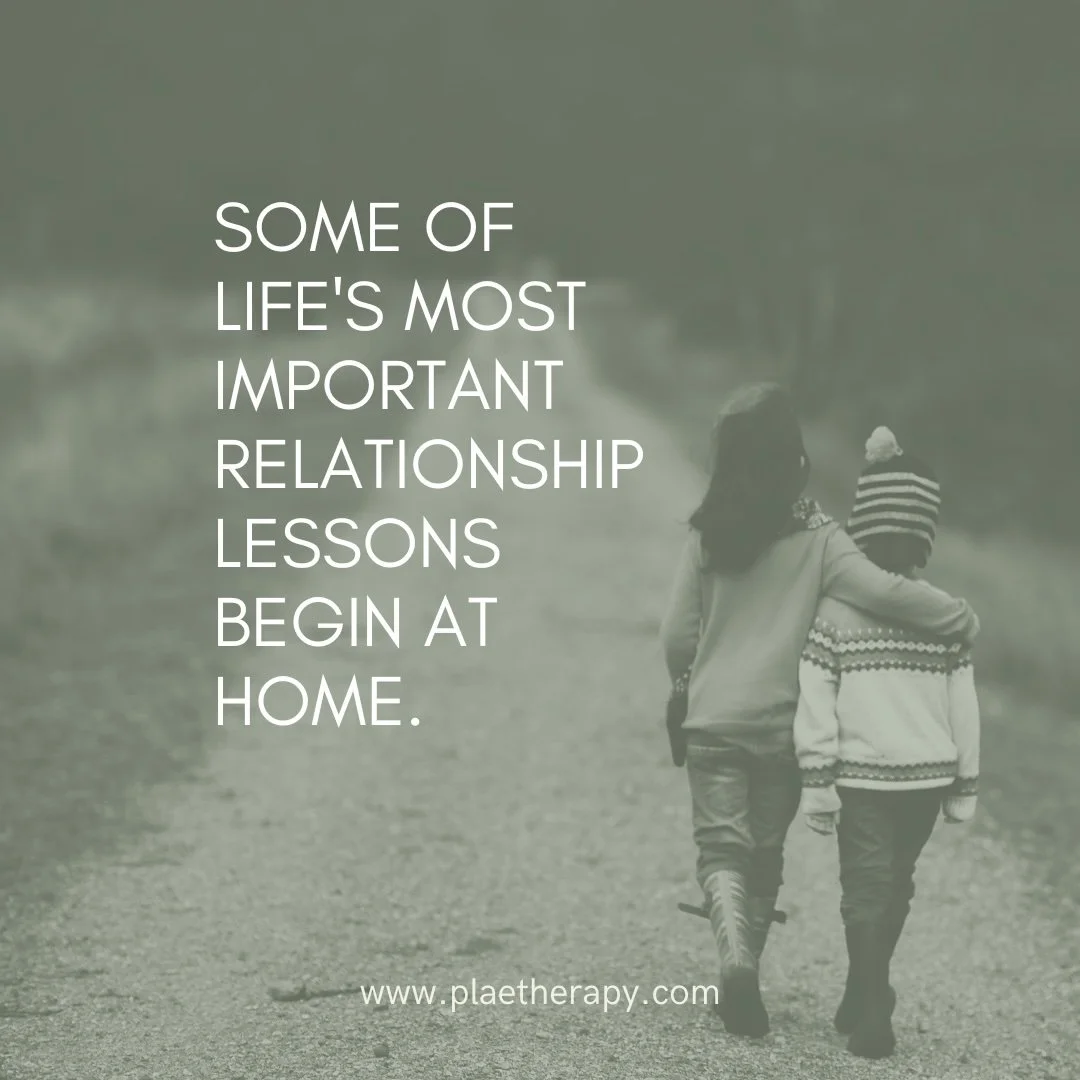
🌿 Why Sibling Relationships Matter More Than We Often Realize
🌿 Why do sibling relationships matter so much?
Sibling relationships are among the most influential relationships of childhood. They become a child's first opportunities to practice communication, empathy, emotional regulation, conflict resolution, and repair—skills that extend far beyond the family and into friendships, school, future partnerships, and adulthood.
In this article, we explore the developmental importance of sibling relationships, why conflict is a normal and valuable part of growing up, and how children can learn to navigate disagreements with greater confidence, compassion, and connection.
🌿 Why Sibling Relationships Matter More Than We Often Realize
From a child development perspective, sibling relationships are among the most influential relationships of childhood. While parents and caregivers provide the foundation for attachment, safety, emotional regulation, and a sense of belonging,
siblings provide something uniquely different—they offer children daily opportunities to practice the relationship skills they will carry throughout life.
Unlike friendships that may come and go, siblings often share years of experiences, routines, celebrations, disappointments, and challenges together. These everyday interactions become a natural classroom for social and emotional development.
Conflict between siblings is not always a sign that something is wrong. In fact, developmentally appropriate conflict provides children with opportunities to build important skills when they are supported in learning how to navigate it. The goal isn't to prevent every disagreement, but to help children develop the tools to move through those moments with increasing confidence, empathy, flexibility, and respect.
Research in child development suggests that positive sibling relationships can support emotional well-being, social competence, resilience, and healthy relationship patterns throughout life. While every family experiences conflict, it is not the presence of conflict that predicts healthy relationships—it is the opportunity to learn, practice, and experience repair.
🌱 Through sibling relationships, children naturally begin learning how to:
Understand and regulate big emotions during moments of frustration and disappointment.
Communicate their needs, thoughts, and feelings more effectively.
Develop empathy by recognizing another person's thoughts, feelings, and perspective.
Negotiate, compromise, and solve problems collaboratively.
Practice healthy boundaries while learning to respect the boundaries of others.
Experience accountability and repair after conflict.
Build resilience by working through challenges instead of avoiding them.
Strengthen flexibility, patience, cooperation, and emotional awareness.
Develop confidence in navigating relationships with peers, teachers, future partners, colleagues, and eventually their own families.
🌿 The Power of Social Learning
Children are constantly learning by observing and interacting with the people around them. Psychologist Albert Bandura's Social Learning Theory reminds us that children develop many of their social and emotional skills through everyday experiences—watching, practicing, receiving feedback, and trying again. Sibling relationships provide hundreds of these learning opportunities each week.
Every shared toy, disagreement, compromise, apology, game, and moment of laughter becomes practice for life beyond the home. These repeated interactions help children gradually strengthen executive functioning skills such as impulse control,
flexible thinking, emotional regulation, perspective-taking, and decision-making. When children are supported through these experiences with guidance rather than punishment alone, they begin developing an internal understanding of how healthy relationships work.
Why Conflict Resolution Matters: Conflict resolution is not simply about stopping arguments. It is about teaching children the lifelong skills needed to maintain healthy relationships.
🌱 When children learn healthy conflict resolution, they begin to:
Conflict resolution is not simply about stopping arguments. It is about teaching children the lifelong skills needed to maintain healthy relationships.
When children learn healthy conflict resolution, they begin to:
Pause before reacting impulsively.
Identify and communicate their emotions with greater clarity.
Listen to understand another person's perspective.
Express disagreement respectfully.
Generate solutions that consider other’s needs.
Repair relationships after hurt or misunderstanding.
Build confidence that relationships can withstand challenges.
Develop emotional resilience instead of fearing conflict.
These skills extend far beyond childhood. They influence how children navigate friendships, participate in classrooms, collaborate with teammates, approach future romantic relationships, work alongside colleagues, and eventually parent the next generation.
As child and family therapists, we have the privilege of witnessing these developmental moments every day. We regularly support children as they discover that healthy relationships are not relationships without conflict—they are relationships where people learn to understand one another, communicate through challenges, repair after hurt, and reconnect with care. By helping children develop these skills early, we are not simply helping them have fewer sibling disagreements today. We are helping them build a relational foundation that can support healthier, more connected relationships throughout their lifetime
🌿 If this resonates with your family and a desire to deepen and support the sibling relationships within your home, , we would love to welcome your children to The Sibling Reset Challenge,.
This will be a two-session therapeutic workshop designed to help siblings strengthen connection while building practical relationship skills. The Sibling Reset Challenge, a two-session therapeutic workshop will be facilitated by Lindsay Drury, CMHC and Grace Miller, LCSW. Wednesdays, August 5 & August 12, 5:00–6:30 PM To learn more or register, visit www.plaetherapy.com, complete our Contact Form, and select "Event." 🌱

About the Author
This was shared by Melanie DeLynne Davis, MS, CMHC, Founder and Clinical Director of PLAE Therapy.
About the Author: Melanie DeLynne Davis, MS, CMHC, Founder and Clinical Director of PLAE Therapy. For more than two decades, Melanie has had the privilege of supporting children, siblings, parents, and families as they navigate the joys and complexities of family relationships through attachment-centered, developmentally informed mental health care.
Her perspective is shaped not only by her work as a child and family therapist, but also by her own life. Melanie is raising three wonderful siblings of her own and has the lifelong perspective of being a sibling herself— she understands firsthand that sibling relationships can be filled with laughter, competition, growth, frustration, forgiveness, and countless opportunities to learn. Anyone with siblings knows there's never a shortage of life lessons!
It is this blend of professional knowledge, clinical experience, and personal appreciation for family life that continues to inspire her passion for helping children and families build relationships rooted in empathy, resilience, healthy communication, and lasting connection.
Understanding Mood Disorders with Compassion, Emotional Awareness Your Emotions Are Information
Our emotions are not signs of weakness—they are one of the ways our minds and bodies communicate with us. 🌿
Too often we're taught to "push through" or "stay strong," but emotional well-being begins when we learn to listen with curiosity instead of judgment.
In this article, we explore how mood disorders differ from the natural ups and downs of life, why emotions are valuable sources of information, and how one simple question—"What do I need right now?"—can shift us from self-criticism toward self-compassion.
May it serve as a gentle reminder that healing isn't about never struggling; it's about learning to care for ourselves with kindness, understanding, and hope. 💚
Understanding Mood Disorders with Compassion
Emotional Awareness: Your Emotions Are Information, Not Weakness
As a mental health therapist, one of the most important things I hope people come to understand is that our emotions are not evidence that something is wrong with us. They are one of the ways our minds and bodies communicate with us.
In many ways, emotions are like an internal language.
They invite us to pay attention.
To slow down.
To notice.
To care.
Yet so many of us were raised with messages that encouraged us to do just the opposite.
We learned to push through.
To stay strong.
To keep it together.
To carry on, even when we were quietly overwhelmed.
While resilience is a beautiful and important strength, there is a difference between resilience and emotional disconnection. When we continually silence what we are feeling, we often become disconnected from ourselves. We begin caring for everyone around us while forgetting to ask what we need in order to remain emotionally well.
Our emotions don't disappear simply because we ignore them.
More often, they patiently wait for us to listen.
Your Emotions Are Information, Not Weakness
One of the gentle reframes I often offer clients is this:
Your emotions are information—not weakness.
They are not flaws to overcome or signs that you are "too emotional." They are not something to fear or judge.
Instead, they are invitations to become curious.
Our emotions often carry meaningful information about our experiences, our relationships, and our needs. They help us recognize when something feels safe, when something feels overwhelming, when something matters deeply, or when our nervous system has been carrying more than it was meant to carry alone.
Sometimes our emotions are quietly saying:
🌱 I need rest.
🌱 I need connection.
🌱 I need support.
🌱 I need healthier boundaries.
🌱 I need time to grieve.
🌱 I need space to process what I've been carrying.
🌱 I need moments of joy, play, and restoration.
Just as physical pain alerts us that our body deserves attention, our emotional experiences often remind us that our hearts and minds deserve care as well.
When Emotional Experiences Become More Than the Ups and Downs of Everyday Life
Being human means experiencing a wide range of emotions. We all move through seasons of joy, disappointment, grief, hope, uncertainty, excitement, and sadness.
Mood disorders are different.
For individuals living with depression, bipolar disorder, or other mood-related conditions, emotional experiences may become more persistent, more intense, or more difficult to regulate. They can influence energy, sleep, motivation, concentration, relationships, and the ability to experience daily life in the ways we once could.
It is so important to remember that mood disorders are not a reflection of someone's character.
They are not a lack of faith.
They are not a failure of willpower.
And they are certainly not a sign of weakness.
Like so many aspects of our health, mood disorders arise through a complex interaction of biology, genetics, life experiences, relationships, trauma, stress, physical health, and our nervous system.
They deserve the same compassion we would extend to any other health condition.
A Gentle Shift Toward Self-Compassion
One question I hear whispered in therapy rooms far too often is:
"What's wrong with me?"
It is a question usually asked with sadness, frustration, or shame.
But what if we gently replaced that question with one rooted in compassion?
Instead of asking,
"What's wrong with me?"
Try asking,
"What might I need right now?"
That simple shift changes the conversation we have with ourselves.
Instead of becoming our own harshest critic, we begin becoming our own compassionate companion.
Perhaps today you need rest.
Perhaps you need nourishment.
Perhaps you need movement.
Perhaps you need a trusted conversation.
Perhaps you need to reach out to a therapist, your physician, or someone who can help carry what has become too heavy to hold alone.
There is profound healing in learning to respond to ourselves with the same gentleness we would so naturally offer someone we love.
Healing Is Not About Never Struggling
One of the greatest misconceptions about healing is that it means difficult emotions disappear.
Healing is not the absence of emotion.
Healing is learning to meet our emotions with greater awareness, understanding, and compassion.
It is recognizing our needs before we reach complete exhaustion.
It is allowing ourselves to receive support.
It is discovering that resilience is not built by never falling—it is nurtured by learning that we do not have to get back up alone.
Often, healing is found in the smallest moments.
A deep breath.
A walk outside.
A conversation with someone who feels safe.
A therapy appointment.
A moment of laughter.
A good night's sleep.
Small moments, practiced consistently, have a remarkable way of becoming meaningful change.
A Gentle Reflection
Take a quiet moment today and ask yourself:
What emotions have been visiting me lately?
What might they be gently asking me to notice?
When do I feel most connected to myself?
What helps my mind, body, and nervous system feel safe?
What is one small act of kindness I can offer myself today?
Sometimes healing begins not by changing what we feel, but by changing how we relate to what we feel.
A Gentle Reminder
If any part of this resonates with you, please know that you do not have to navigate it alone.
Whether you are living with a mood disorder, moving through grief, navigating a season of change, or simply feeling unlike yourself lately, support is available.
As therapists, we have the privilege of walking alongside people during some of life's most vulnerable moments. We don't simply see symptoms or diagnoses—we see human beings with stories, strengths, relationships, and an incredible capacity for healing.
There is hope.
Even when it feels distant.
Healing is rarely about becoming someone different. More often, it is about gently finding your way back to yourself—with compassion, with support, and with the reminder that you were never meant to carry everything alone.
🌿 With warmth and compassion,
The PLAE Therapy Team
🌱 If we can support you in any way, please reach out… www.plaetherapy.com


Summer as a Planting Season; Finding Growth in the Gentle Pace of Practice
Summer as a Planting Season
Finding Growth in the Gentle Pace of Practice
For many mental health providers, summer brings a noticeable shift. Calendars slow, routines change, and our practices often take on a different rhythm. While it can be tempting to view this season through the lens of productivity or worry, what if we embraced it as something entirely different?
What if summer wasn't simply a slower season... but a planting season?
Just as nature reminds us that healthy growth requires seasons of blooming, deepening roots, and quiet restoration, our professional lives flourish when we honor these rhythms as well. Whether you're investing in your own growth, nurturing your practice, exploring a long-awaited creative project, or simply allowing yourself space to rest, this season offers a beautiful invitation to plant seeds that will sustain you long after summer has passed.
May this article encourage you to embrace the gentle pace, trust the process, and discover the meaningful growth that often begins beneath the surface.
There is something about summer that quietly changes the rhythm of our practice... when allowed space.
For many mental health providers, calendars begin to shift during the summer months. Families leave for vacations. College students return home. Children trade classrooms for camps, swimming pools, bike rides, and long afternoons outdoors. Parents' schedules look different. The pace of the community changes, and often, so does the pace of our mental health and wellness practices.
For some clinicians, this means a noticeable slowing in referrals or client attendance. For others, it creates an entirely different kind of consistency. Many clients who spend the school year juggling endless responsibilities suddenly have room to breathe. Without the constant demands of academics, extracurricular activities, and the social complexities that accompany the school year, they often have greater emotional bandwidth to engage in their healing. Children who tend tostruggle with the structure and demands of school may experience a season of relief, while others find that camps and summer activities provide meaningful support and connection. Summers are quite free for our family. I call them '80skids' summers. We do not do many camps, if any. We bike ride, hop local for a meal to make the same day, enjoy the lovely presence of community options like free libraries, and summer reading programs at the public library. These are for adults and children... I am still enjoying my evening magnesium drink from the Salt Lake City Library mug I earned a few summers back for meeting my reading goals.
Whatever the reason, summer often brings change.
As providers, we have some opportunities in how we receive that change and flow within our private practices and as providers and be intentional.
It can be easy to look at a lighter calendar and feel anxious. I remember this in my initial years both working at a private practice for many years and then close to a decade ago when I opened my own practice. I recall finding myself wondering if I should be doing more, marketing more, networking more, or worrying about what the fall will bring. My nature as an anxious individual and planner lent to the absence of mindful presence in many instances... of the steady exploration of productivity. In a profession built around caring for others, it is not uncommon to measure our productivity by how full our schedules are.
But what if we looked at this season differently?
What if summer wasn't simply a slower season?
What if it was our planting season?
I have long believed in the planting, nurturing, and harvest or blooming season of life, people, and time. This symbolism is what our practice is named after, Planted Healing...
Nature reminds us that growth has never depended on every season looking the same. In fact, my two favorite blooms are Cherry Blossoms and Tulip Tree Blossoms. After many beautiful years in the Washington, D.C., area, I grew to love, appreciate, and notice the cherry blossom phenomenon. When we bought our modest 1940 bungalow many years back, it was the first tree I planted in our front yard just a few feet from our living room window. The Cherry Blossom has Growth Stages, Bud Formation, Blooming, between March and April, depending on the climate. The blossoms reach their peak for about a week to ten days, creating a breathtaking display. It is breathtaking. It is my favorite pink; it captures the beauty of spring! After this brief peak bloom, petals fall... The tree lives as a beautiful green leaf tree throughout the summer, sheds all its leaves in the fall and winter, and then repeats the process again. There is a time for blossoms, a time for abundance, a time for harvest, and a time when growth is happening quietly beneath the surface.
The strongest trees do not spend every moment producing fruit or blossoms. They spend seasons deepening their roots, strengthening their trunks, and preparing for what comes next.
Perhaps our professional lives are meant to follow a similar rhythm. Who and what could we be if we fully embrace this both as people, with our moods, with our energy, with our productivity, sleep cycles, and our permissions for relationships even.
Maybe the quieter moments of summer are not interruptions to our work. Maybe they are an essential part of it.
Rather than filling every open space, perhaps this is the season to plant, nourish, or water.
To plant into ourselves.
To plant into our practices.
To plant into our creativity.
To plant into our development.
To plant into the future clinician we are still becoming.
Summer offers a rare invitation to pause long enough to notice the places that have quietly been asking for our attention.
Perhaps this is the season to return to your own therapy or seek consultation that helps you think differently about your work. Maybe it is finally time to read the books stacked beside your bed, attend the training you've bookmarked for months, or explore a new clinical modality that has sparked your curiosity. Every investment you make in your own growth eventually becomes something your clients receive. Leaning into what we offer others and continuing to cultivate this within ourselves.
It may also be the season to tend to your practice itself. Are there new systems that would enhance the flow and feel for clients as they share time and space with you in the spaces and places you have curated? If you run a private practice, do your providers need more supports or warmth poured into them? The small things are meaningful...
During busier months we often spend our days responding to immediate needs, moving from session to session with little margin between them. For established and well-running practices, these times are the norm and are present the majority of the year.
Leaning into allowing summer to create space to work on your practice as a provider instead of always working in it. A few additional planting ideas for practice owners... have you peeked at your website, organized your therapeutic resources, updated paperwork, refined policies, strengthened referral relationships, or simply created systems that allow your future self to breathe a little easier?
These quiet investments often become the things we are most grateful for when life inevitably becomes busy again.
Summer can also become a season for the projects that have patiently waited in the background as individuals.
Many of us carry ideas that quietly whisper, Someday.
The book you've always wanted to write.
The intervention you've been developing in your mind.
The therapy group you've imagined offering.
The workshop your community could benefit from.
The research article waiting for your voice.
The podcast, blog, artwork, or creative endeavor that reflects who you are beyond your role as a clinician.
Not every project needs to become a polished product or another accomplishment to add to your résumé. Some projects exist simply to reconnect us with our creativity, our curiosity, and the joy that first drew us into this work.
Sometimes creating something beautiful is enough.
The beginning can be simple... quiet... slow...
It may simply look like opening a notebook.
Writing one page.
Sketching one idea.
Making one phone call.
Registering for one course.
Taking one afternoon to imagine what has been living quietly in your heart.
Seeds are never judged for how quickly they become trees.
They are simply given the conditions to grow.
Perhaps we deserve to offer ourselves that same grace.
Summer is also a beautiful season to reconnect with community.
Private practice and small group practice can become surprisingly isolating. We spend our days deeply connected to clients, and even if passing our colleagues in the hallways for a coffee refresh, we can unintentionally become disconnected from one another. A slower season offers opportunities to meet another therapist for coffee, attend consultation groups, collaborate across disciplines, mentor someone newer to the field, or simply remember that we were never meant to carry this work alone.
And then there is perhaps the most important invitation of all.
Rest.
Many providers and those of us who were designed to work in the helping professions struggle with rest. Somewhere along the way, some of us have learned to associate our impact and successes with constant productivity. I was so deeply grateful to release so much of this a decade or so ago.
Empty spaces might make you a bit uncomfortable initially, but wow, are they powerful for creativity, human design windows, and balancing our nervous systems. Resist the innate desire to reach to fill them.
Every healthy ecosystem reminds us that rest is not the absence of growth.
It is part of growth.
Rest allows our nervous systems to regulate.
It restores creativity.
It deepens compassion.
It strengthens relationships.
It reminds us that before we are therapists, we are people.
The people we serve do not simply benefit from our knowledge or our clinical skills. They benefit from our presence. They benefit from providers who have learned how to care for themselves with the same compassion they extend to others.
As summer gradually gives way to fall, calendars will begin filling again. Schools will reopen. Families will settle back into routines and schedules. Referrals will likely increase and steady, and the familiar pace of practice will return. You will also realize that this two-month period each year could be nature's gift.
When it does, we can carry forward more than a well-managed schedule.
We can carry deeper roots.
We can carry and flow with fresh ideas.
We can carry restored energy.
As a Private Practice Financial Tip: I recognize it can take time and require sacrifice to bring yourself into this pacing. Planning through the year financially is important and typically critical to balance out your ebb and flow for your personal needs. As a measure, that could be an entire in-depth share in itself. An approach could be to assess your slower planting seasons and the time they usually occur. Two months, perhaps? Take a portion of your 10-month harvest seasons and plant it somewhere thoughtful, ideally an open-ended, high-interest holding space. While you are in harvest season, those blossoms are preparing and will be ready to provide for your planting season.
My hope for you... I hope we carry the confidence that comes from knowing we used this season well—not because we stayed busy, but because we found intention. The strongest trees are not built in a single season.
Both are shaped by countless quiet moments of tending, nurturing, waiting, and trusting that growth is happening long before it becomes visible and when it is least visible.
May this summer or whenever your slower moments present themselves, be your planting season or an opportunity to plant the ideas of how to explore the year to come to prepare for the next season.
Sending you love, light in the sunny days, and stillness to see the beauty in all of it.
Melanie DeLynne Davis, CMHC